
certainly  I will have to absorb all this but I will be back! I know my reputation is #1 Narvin fan around here but of all the Gally characters, Leela holds my heart most of all <3
9 Likes
I shall look forward to it. 
I just LOVE how much there is to discuss when we look under the bonnet of our favourite SF series (and its manifold - and frequently marvellous) spin-offs).
8 Likes
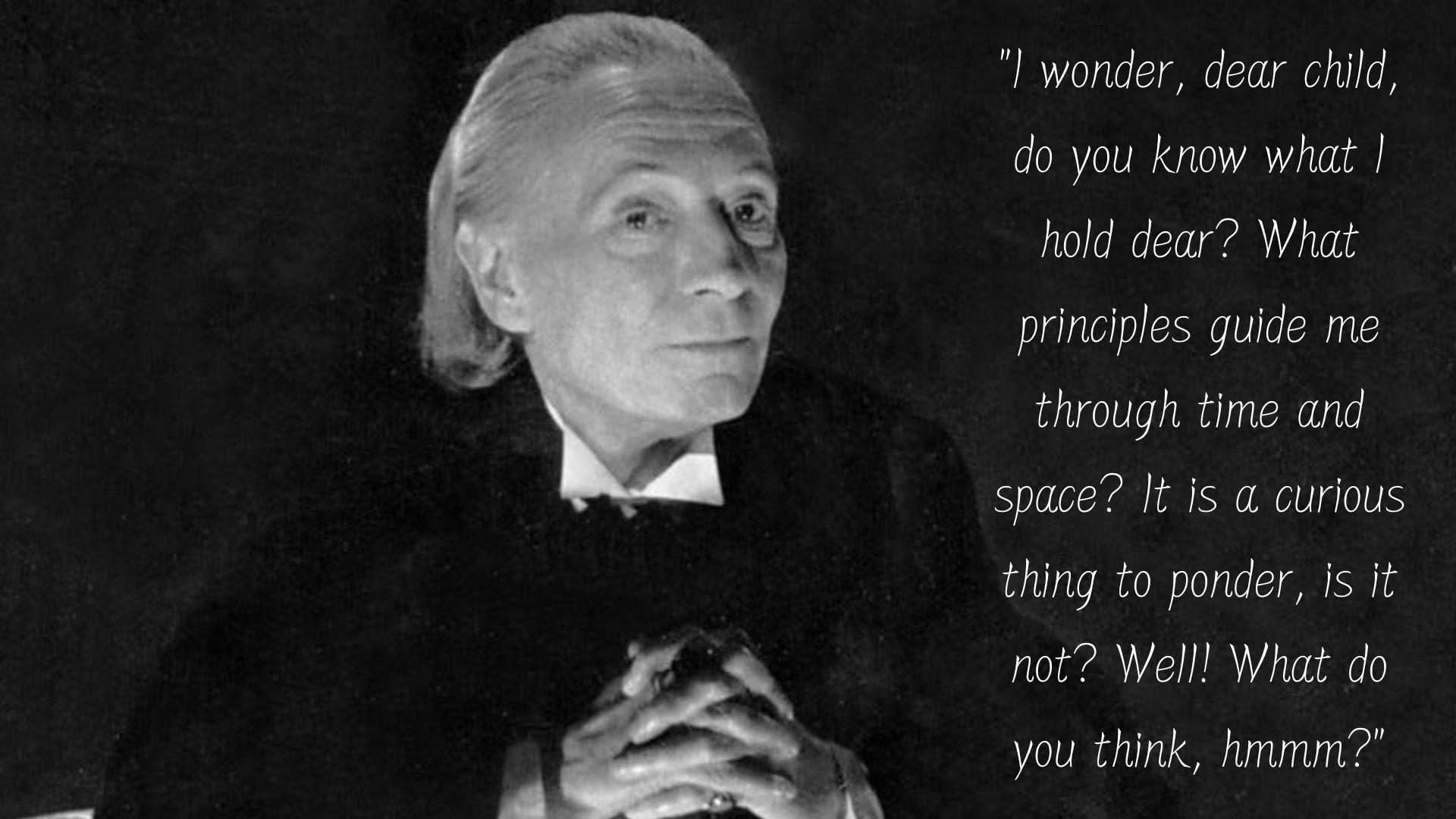
I think that’s a good idea, it would make for an interesting read!
5 Likes
I think that would be super interesting, especially considering that he’s fresh of Gallifrey and so many of his moral principles will change throughout time and him only starting to develop that strong moral core, I’m thinking for example of edge of destruction, where he starts to respect his human companions
9 Likes
I really think you’ve captured the thirteenth doctor’s philosophy perfectly here, it fits really well with her actions. Really impressive analysis!
(Also I will have to think about Leela from this point of view too, because interestingly, I think her words and her actions and actual judgement are so compelling and don’t always match)
8 Likes
But…
9 Likes
Thank you! I really find this thread, and the What Maketh a Monster? thread are offering me more ways to find yet more to enjoy and admire about DW. Sometimes I go in thinking it will be more straightforward, but in every case have found layers and new angles to appreciate.
I have another analytical thread that’s been eating away at me, and shall unveil soon… but I think I’ll leave that one until the new year.
As for the first Doctor, I agree. I’ll delve into Season 1 next (though please feel free to discuss anything and everything I’ve covered so far; season 8, Flux etc.). Each of my posts is only ever the start of the conversation. I love going deeper and delight in the angles that you all see and I might have missed or skipped over.

10 Likes
Oops, thanks for this. Corrected, and yet…
…I remain certain that the Doctor ALSO values freedom for otters too. 

11 Likes

4 Likes
Season 1 (1963-1964) was where it all began and, as such, sets a useful baseline for us to consider in our philosophical exploration of the Whoniverse. We are all aware that the Doctor undergoes significant character development in the first season. Moreover, although there are periods where the Doctor’s position is more or less static, the character has broadly continued to evolve philosophically, morally and politically over the past 61+ years. Let’s go right back to the beginning, however, and explore the Doctor’s intellectual and moral world as it was at the very start of the series.
In season 1, the Doctor’s dominant and most consistent philosophical positions are dominated by pragmatism, anti-interventionism and moral relativism. Over the course of the season, he does however develop a more humanist view of the universe (helped, in no small part, by his companions). In short, this season sets up the moral and philosophical development that the Doctor has shown over the past 6+ decades.
From the very beginning of Season 1, the Doctor embodies pragmatism. He consistently prioritises actions that lead to the outcome he desires, even if it means behaving (especially in the earliest stories of the season) selfishly, manipulating others and whatever he was planning on doing to the injured Za with that infamous rock in episode 3 (The Forest of Fear) of An Unearthly Child. At least initially, the Doctor shows willingness to lie and deceive his companions to achieve his goals (as exemplified in episode 1 of The Daleks). During The Edge of Destruction, the Doctor tells Ian he has a theory that didn’t work, when in fact, he is lying to protect Barbara and Susan from the knowledge of their imminent demise: “I lied, deliberately, so that they won’t know".
The Doctor consistently demonstrates a willingness to make deals or bargains when necessary to achieve his goals. In The Sensorites he agrees to speak with the First Elder and asks for cooperation. His focus is on achieving results, such as finding cures, or exposing the truth. This is reflected in his unquenchable curiosity and desire to learn more. The Doctor consistently demonstrates a strong desire to explore and understand the universe, often placing this above immediate safety and comfort (one of the most notable examples of this can be seen in the aforementioned example from The Daleks). He demonstrates a consistent fascination with new places, cultures, and technologies. He expresses great interest in learning about the planet Marinus. He seeks to understand the construction of the Aztec (Mexica) temple. He wishes to understand Sensorite technology.
The Doctor’s motivation within stories is often to understand the causes of the problems he encounters. He seeks to understand why the TARDIS is malfunctioning during The Edge of Destruction. He wants to know why people are dying during The Sensorites. His belief in the power of knowledge and learning is consistent and defining (and continues to define the Doctor’s character to this very day). Indeed, he shows visible disappointment when others do not value learning and knowledge.
Across season 1, we see the Doctor re-evaluate his approach to exploring the universe. Despite his sometimes detached demeanor, the Doctor gradually develops a deep concern for the well-being of others, and comes to believe in the potential of individuals to do good, or find good. This marks the start of the Doctor’s fondness for humanity. Indeed, he doesn’t exactly seem overly enamoured with Homo sapiens initially, showing himself to be irritable and easily aggravated. There is a strong comparison to be made with a similar arc that we see play out for the Ninth Doctor in Series 1 (it isn’t that Nine doesn’t particularly like humans initially, more that he is jaded, cynical and dismissive post his Time War traumas), with Rose playing the role that Barbara and Ian do in gradually helping the Doctor to see the positivity and potential of humanity once more.
Back to season 1 and we the the First Doctor show increasing willingness to help those in need, even when it puts himself at risk. He defends Ian against the accusation of murder during the penultimate episode of The Keys of Marinus. His belief in the value of human life (indeed, life in general) and his opposition to unnecessary violence becomes ever more apparent. His tendency to offer comfort, understanding and compassion increases across the season. The Doctor acknowledges the grief Sabetha feels for the loss of her father in The Keys of Marinus, and demonstrates early signs of the optimistic outcome that would become so central to Doctor Who when he tells the Thals that they may live to see and hear the birds amongst the trees. Season 1 may mark the start of this increasingly humanist attitude in Doctor Who, but it is clear that humanism is an important philosophical position both for the Doctor AND the series as a whole.
One area I find of great interest is the approach of the series (and, of course, of the Doctor) to other cultures, societies and species. He acknowledges that different species and cultures may have their own unique values and ethical frameworks. This is demonstrated in a number of ways, including:
- …his belief that truth is not absolute. He states that “My truth is in the stars and yours is here”, indicating different truths for different species and different perspectives.
For a show that typically expresses the importance of a scientific and frequently reductionist approach to the puzzles encountered, this element of relativism and, at times, constructivism, is both nuanced and surprisingly mature (and chimes well with the postmodernist approach of several stories throughout the history of the show).
A less consistent theme, but still present in the Doctor’s actions, in that he sometimes expresses reluctance to interfere in the affairs of others, though he often ends up doing so. We’re going to see the Doctor become increasingly interventionist in later incarnations and stories, so it’s interesting to see him aligning much more closely with Gallifreyan non-interventionism (many years before we even knew that Gallifrey existed). Consider:
- His recognition that meddling can have unintended consequences. He says he learned not to meddle in other people’s affairs years ago.
- His reluctance to impose his values on others. In The Aztecs, the Doctor says that what Barbara is trying to do is impossible, but then says that it is up to her what happens next.
- His desire to allow others to determine their own paths. He tells the Thals to “search for truth” for themselves.
In summary, the Doctor during season 1, is most consistently a pragmatist and a seeker of knowledge, who is also increasingly driven by humanistic ideals and a belief in individual potential. He is not always consistent, however. He also sometimes expresses moral relativism and a desire to avoid intervention, but these are less consistent and sometimes contradictory. His actions and words across all the sources reveal a complex character driven by a desire to learn, explore, and ultimately, to do what he believes is right, even if his methods are sometimes unconventional or questionable.
This is but the beginning. Philosophically, Doctor Who has continued to evolve over the decades. We have a long way to go. Perhaps next time, I’ll delve into something more recent?
6 Likes
My choice for something more recent has been made. Keen to explore something more recent and something with deep philosophical resonance, I shall be delving deeper into:
The Story & the Engine next time. Now this is one that I’m really looking forward to unpacking. Strap in folks, it’s gonna be a fun ride around the storytelling nexus!
Oh, and I really am going to have fun with this one. I was fortunate enough (very fortunate indeed) to be taught, first hand, by the great David Miller (once, a research assistant to Karl Popper himself and one of the clearest proponents of critical rationalism) and I can see plenty of fertile ground to explore. This might be a little self indulgent, but I’m really looking forward to it. Oh, and the existentialism of it all! I know it’s perhaps a little odd but I’ve always been caught between the very different schools of Popper’s critical rationalism and Sartre’s existentialism. I don’t believe for a minute that they are contradictory as both have much to say about how we make sense of the universe (critical rationalism) and, crucially, how we make sense of ourselves (existentialism). This story has so much to offer on both counts (and more besides). My my! I’m going to have so much fun. 
Please forgive me!

4 Likes
Philosophy in “The Story & the Engine": Exploring the Limits of Scientific Knowledge, the Nature of Meaning, Identity, and the Importance of Human Agency
Doctor Who has always been fertile ground for philosophical inquiry (as I hope I’ve been able to demonstrate in my previous posts on this thread). The Story & the Engine is no exception. Indeed, Inua Ellams’ delightful story proves to be sumptuously rich when we turn a philosophically minded eye towards it. Ellams’ story invites readers and viewers to confront profound questions about knowledge, existence, and human value. Through its narrative about the Doctor, the Barber, and the strange, reality-bending barbershop, the story interrogates multiple philosophical traditions. I’m going to consider a selection, including; Logical Positivism, Critical Rationalism, Existentialism, and Humanism. Additionally, I shall touch more briefly on engagements with; Nihilism, Narrative Theory, and Virtue Ethics.
Rather than bore everybody rigid with an enormous and wordy essay, I’m going to break this down into a series of posts (as, I feel, one of my favourite stories deserves). Today I’m going to pay attention to how The Story and the Engine engages with scientific method and a scientific approach to knowledge (specifically through the related, though by no means synonymous, lenses of Logical Positivism (as exemplified by Ayer and the Vienna Circle) and Critical Rationalism (first articulated by the great Karl Popper and championed by sharp thinkers such as David Miller).
5 Likes
A Rejection of Logical Positivism?
Logical Positivism (LP) holds that a statement is meaningful only if it is empirically verifiable or analytically true. LP has, across the years, gained considerable currency with many within the scientific community. Does it fit within Doctor Who’s vision of the universe? There are certainly stories where we see some reflection of Positivist attitudes. Indeed, any time where the Doctor engages with finding verifiable empirical evidence would fit. The Story & the Engine, however, is radically different and is frequently shown to be opposed to this view. The very premise of the story is steeped in metaphysics and unverifiable phenomena: gods and story lords roaming the universe, barbershops that compress / distort space and time, and a literal “story engine” that powers reality through narrative. These are not merely colourful plot devices; they are the fabric of the narrative itself. The central conflict celebrates the transformative power of stories and myths (concepts Logical Positivism would dismiss as meaningless). In doing so, the story implicitly rejects LP’s reduction of meaning to verification, insisting that some of the most vital aspects of existence lie beyond empirical measurement. Does this, then, mean that The Story & the Engine, is in any sense “anti-science”? I shall argue that this is not the case.
Critical Rationalism and the Doctor’s Method
Critical Rationalism (CR), associated with Karl Popper, argues that knowledge grows through conjecture and refutation rather than final proof. Hypotheses are proposed and tests devised to attempt to knock down these hypotheses. Any idea that survives rigorous attempts to disprove it becomes accepted into the current scientific consensus. Popper famously asserted that “we never know, we only guess” and that science advances through bold conjectures exposed to rigorous attempts at falsification. David Miller extended this idea by emphasizing that what matters is not verification but the systematic elimination of error through criticism. In this sense, CR represents a more rigorous examination and explanation of scientific method than LP and provides a clearer evidential standard for us to meet. Crucially, it is also more accepting that knowledge is a fluid concept which grows over time, whilst also subject to modification on the basis of improved evidence. Moreover, CR posits that the application of rigorous scientific method is the most reliable way to truly advance knowledge via the search for truth.
Critical Rationalism is vividly embodied in the Doctor’s approach to the Barber’s trap. When the Barber claims divine status, the Doctor does not accept the claim at face value. He draws upon his own (vast) past experience to falsify it: “I know the gods. You are not them.” This is a textbook example of Popperian falsification: a claim is tested against available evidence, found to be wanting, and rejected when contradicted.
The Doctor’s actions go further, mirroring Popper’s notion of elimination by trial and error (very Sherlockian: When we eliminate the impossible, whatever remains - however improbable - must be true). When confronting the customers’ belief that they can’t leave, he actively tests this hypothesis by opening the door, risking catastrophe to see what will happen (this is both an example of Critical Rationalism and constructive skepticism in action AND ALSO an action absolutely in line with the reckless impulsiveness of the Fifteenth Doctor). This moment dramatises the Popperian ideal of learning through risk: genuine knowledge requires exposure to possible refutation. As Popper suggested, progress depends on being willing to stake a claim that could be proven wrong - and facing up to the consequences of being wrong.
Even the Doctor’s argumentative style reflects Critical Rationalist philosophy. He constantly challenges assertions, probes motives, and demands explanations, enacting what Miller called the “critical attitude,” where rationality consists not in possessing secure foundations but in subjecting ideas to continual scrutiny. The story thereby presents science and knowledge not as a collection of verified facts but as an ongoing process of inquiry, criticism, and discovery. This is remarkably astute.
I adore this story and really respect the different ways that it engages with ideas that are profoundly important. Scientific method, confidence in knowledge and the eternal search for truth certainly tick these boxes. There’s so much more I could say on this, yet I hope my central arguments are clear (though, please feel free to discuss or ask questions if you have an intellectual itch related to anything I’ve written so far).
Next, I shall delve into an analysis of what The Story & the Engine has to say about identity, existence, essence and meaning. Yes, we’re taking a trip into the realms of existentialism. 

6 Likes